
This content is provided for informational purposes only and does not constitute medical advice. Consult a qualified healthcare professional for any decision regarding your health.
Knee pain can come from a torn ligament, a worn joint, or a damaged meniscus — and in each scenario, the same specialist steps in: the orthopedic surgeon. Whether the condition results from sports trauma or gradual degeneration, this specialty covers the full range of knee pathologies, from diagnosis through to surgical intervention and post-operative follow-up.
What Exactly Does an Orthopedic Surgeon Do?
The orthopedic surgeon specializes in the entire musculoskeletal system — bones, joints, ligaments, tendons, and muscles. Within that broad territory, the knee stands as one of the most frequently treated anatomical structures, given its exposure to both sports-related trauma and age-related wear. According to a key point from HAS recommendations, the orthopedic surgeon is defined as the specialist for musculoskeletal conditions, with recognized specific competencies for knee pathologies.
This scope means the specialist handles cases that go well beyond what a general practitioner or physiotherapist can manage. When structural damage is confirmed through imaging — a ligament tear, cartilage loss, or a fractured bone — surgical intervention enters the picture. The orthopedic surgeon evaluates whether a conservative approach (physiotherapy, bracing, injections) is still viable, or whether the anatomy requires direct repair.
One common point of confusion concerns the boundary between the orthopedic surgeon and the rheumatologist. The rheumatologist focuses on inflammatory and autoimmune diseases (such as rheumatoid arthritis) and manages these conditions medically, without performing surgery. The orthopedic surgeon, by contrast, intervenes surgically when a structural problem has been identified. Both specialists may follow the same patient, but their respective roles are clearly distinct. A further distinction can be drawn with sports medicine physicians, who handle non-surgical rehabilitation, sports-related injuries in their early stages, and return-to-sport protocols.
When knee pain persists despite initial conservative treatment, or when imaging reveals structural damage, the general practitioner typically issues a referral to an orthopaedic knee surgeon for a specialized assessment. At that consultation, the specialist maps out the full clinical picture — comparing symptoms, imaging results, and the patient’s functional expectations — before proposing a course of action.
Common Knee Surgeries Performed by Orthopedic Specialists
Knee surgery is not a single procedure: it covers a range of interventions adapted to specific pathologies. The appropriate technique depends on the nature of the damage (traumatic vs. degenerative), the patient’s age and activity level, and the degree of functional loss. Three main categories account for the vast majority of interventions encountered in clinical practice.
90%+
Success rate for total knee replacement surgery after 10 years, according to EFORT
According to an analysis of practices published by EFORT, knee replacement surgery achieves a success rate of over 90% after ten years, and minimally invasive techniques have contributed significantly to shortening hospitalization durations. This figure reflects a broader shift in orthopedic practice toward procedures that limit tissue disruption while maintaining surgical precision.
- Arthroscopy (minimally invasive repair)
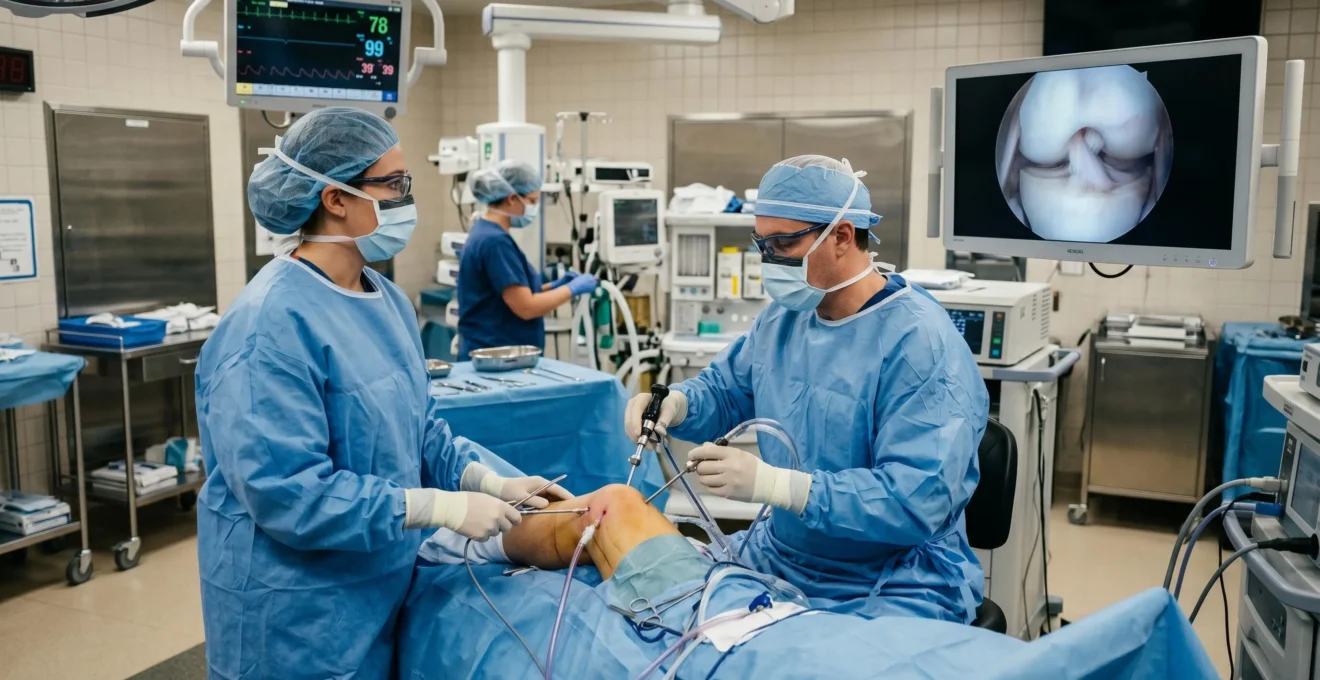
Used for meniscus tears, cartilage damage, and ligament evaluation. A small camera enters the joint through a minor incision. Recovery is generally faster than with open surgery, and the patient is often mobile within days.
- ACL reconstruction and multiligament surgery
Indicated when one or more ligaments have ruptured — most often in younger or active patients following a sports trauma. The torn ligament is replaced using a tendon graft (taken from the patient or a donor). This is a technically demanding procedure requiring precise graft positioning to restore joint stability.
- Knee arthroplasty (partial or total replacement)
Reserved primarily for advanced osteoarthritis. The damaged joint surface is replaced by an implant. Total knee replacement involves the entire joint; unicompartmental arthroplasty targets only the affected compartment, preserving the healthy part of the knee.
A typical scenario that orthopedic surgeons encounter involves a recreational runner in their mid-forties who has experienced persistent medial knee pain for several months. After a non-surgical approach fails to resolve the symptoms, an MRI reveals a degenerative meniscus tear combined with early compartmental cartilage loss. Depending on the extent of the damage, the surgeon may propose an arthroscopic debridement — or, if degeneration is more advanced, discuss whether unicompartmental replacement better serves the patient’s long-term functional goals.
When Should You See an Orthopedic Surgeon for Knee Problems?
Not every knee pain warrants an immediate surgical consultation. In practice, however, a number of warning signals indicate that a generalist’s advice is no longer sufficient — and that structural assessment by a specialist has become necessary. Identifying these thresholds early can prevent a condition from worsening and shorten the overall treatment timeline.
The data from updated Assurance Maladie records show that in France, 120,000 total knee replacements were performed in 2023 — a 5% increase compared to 2022, with an average hospital stay of 4 days. These figures point to both a growing volume of patients reaching the surgical threshold and a general trend toward streamlined recovery pathways.
- If your knee pain has lasted more than 6 weeks without improvement:
A standard GP follow-up is unlikely to be sufficient. Request a referral for imaging (MRI or X-ray) and a specialist consultation to rule out structural damage.
- If you experienced a sudden injury during sports (pivoting, contact, fall):
A ligament or meniscus injury should be assessed promptly. Disabled diagnosis of an ACL tear can lead to secondary joint damage. Orthopedic evaluation is warranted within the first two weeks.
- If you have been diagnosed with osteoarthritis and daily activities are increasingly limited:
When pain at rest, walking difficulty, or stair climbing become regular obstacles, the condition may have progressed beyond what conservative management can address. Arthroplasty options can be discussed with a specialist.
- If your pain is inflammatory in nature (swelling, warmth, bilateral symptoms):
These signs may point to a rheumatological rather than mechanical cause. In this case, a rheumatologist should be consulted first before any surgical evaluation is considered.
Timing matters significantly in knee surgery outcomes. Ligament reconstructions performed at an appropriate stage — before secondary meniscal or cartilage damage accumulates — tend to deliver more complete functional restoration. Conversely, delaying a total knee replacement well past the point of severe joint degradation can complicate the surgical procedure and extend rehabilitation. The specialist’s role at the consultation stage is precisely to map where the patient’s condition sits on this spectrum.

Your Questions About Orthopedic Knee Care Answered
Patients approaching a first orthopedic consultation frequently carry a set of practical concerns — about the necessity of surgery, the differences between specialists, and what recovery realistically looks like. The questions below address the most common uncertainties, drawing on the clinical frameworks referenced throughout this article.
Can an orthopedic surgeon treat knee conditions without operating?
Yes. The surgical consultation does not automatically lead to an operation. The orthopedic surgeon may recommend a structured physiotherapy program, intra-articular injections, or orthotics as a first-line approach. Surgery is proposed when conservative options have been exhausted or when the structural damage makes non-surgical management unlikely to restore adequate function.
What is the difference between an orthopedic surgeon and a rheumatologist for knee conditions?
The distinction lies in the nature of the pathology and the type of treatment. Rheumatologists manage inflammatory and autoimmune conditions (rheumatoid arthritis, gout, ankylosing spondylitis) through medication. Orthopedic surgeons address mechanical and structural damage — ligament tears, meniscus injuries, advanced osteoarthritis — through surgical repair or reconstruction. Both may be involved in a patient’s care at different stages.
How long does recovery take after knee surgery?
Recovery duration depends directly on the type of intervention. Arthroscopic procedures typically allow weight-bearing within days, with a return to light activity within a few weeks. ACL reconstruction involves a more extended rehabilitation period — often several months before full sporting activity resumes. Total knee replacement requires a structured rehabilitation program, with the average hospital stay standing at 4 days according to Assurance Maladie data. Each patient’s timeline is shaped by their baseline health, the complexity of the surgery, and adherence to rehabilitation protocols.
How is the right knee surgeon identified?
Several criteria are worth verifying: the surgeon’s sub-specialization (not all orthopedic surgeons have the same focus — some concentrate on arthroplasty, others on sports traumatology and ligament surgery), the volume of similar procedures performed annually, affiliation with academic or research institutions, and involvement in recognized professional societies. A second opinion is always a valid step before consenting to an elective procedure.
One area that often generates uncertainty is the use of robotic assistance in knee arthroplasty. This technology refines implant positioning during surgery, with the aim of improving alignment and reducing variability in outcomes. Its use does not change the recovery pathway fundamentally, but it represents one of the technique evolutions highlighted in current European orthopedic practice — alongside the broader move toward minimally invasive surgery and accelerated rehabilitation protocols. Understanding that these approaches are standard in high-volume knee surgery centers helps demystify the operative experience for patients weighing their options.
For those who want to situate knee health within a broader perspective on preventive care and early detection, the question of early diagnosis through medical imaging is directly relevant — imaging remains the primary tool by which orthopedic surgeons confirm the nature and extent of structural damage before any intervention is decided.
Important: Knee surgery outcomes vary significantly depending on individual patient factors. The information presented here describes general clinical frameworks and does not replace a personalized assessment by a qualified orthopedic surgeon.
Ultimately, the relevance of orthopedic surgery for knee conditions is well established — both for acute traumatic injuries and for long-standing degenerative pathologies. The deciding factor is always the balance between the degree of structural damage, the patient’s functional goals, and the response to prior treatments. An informed consultation, backed by quality imaging, is the only reliable way to determine whether and when surgical intervention serves the patient’s interests. You can also learn more about the importance of prevention in healthcare, which shapes how early knee conditions are detected and managed before they escalate.
What to remember about orthopedic knee surgery
- Request an MRI or X-ray before the specialist appointment — imaging is essential for structural assessment
- Note the exact circumstances of pain onset (sports injury, gradual onset, morning stiffness) to guide the diagnosis
- Verify the surgeon’s sub-specialization — ligament surgery and arthroplasty require distinct expertise
- Ask explicitly about non-surgical options during the consultation before agreeing to any procedure
The most useful shift in perspective is this: an orthopedic consultation is a diagnostic step, not a surgical commitment. Arriving with quality imaging and clear symptom history gives the specialist everything needed to map out the most appropriate pathway — whether that leads to rehabilitation, injection therapy, or a planned intervention.
Limits of this content: This content is informative and does not replace a personalized medical consultation. Each patient requires an individual evaluation by a qualified professional. General recovery timelines and success rates presented here reflect population-level data and may differ from individual outcomes.