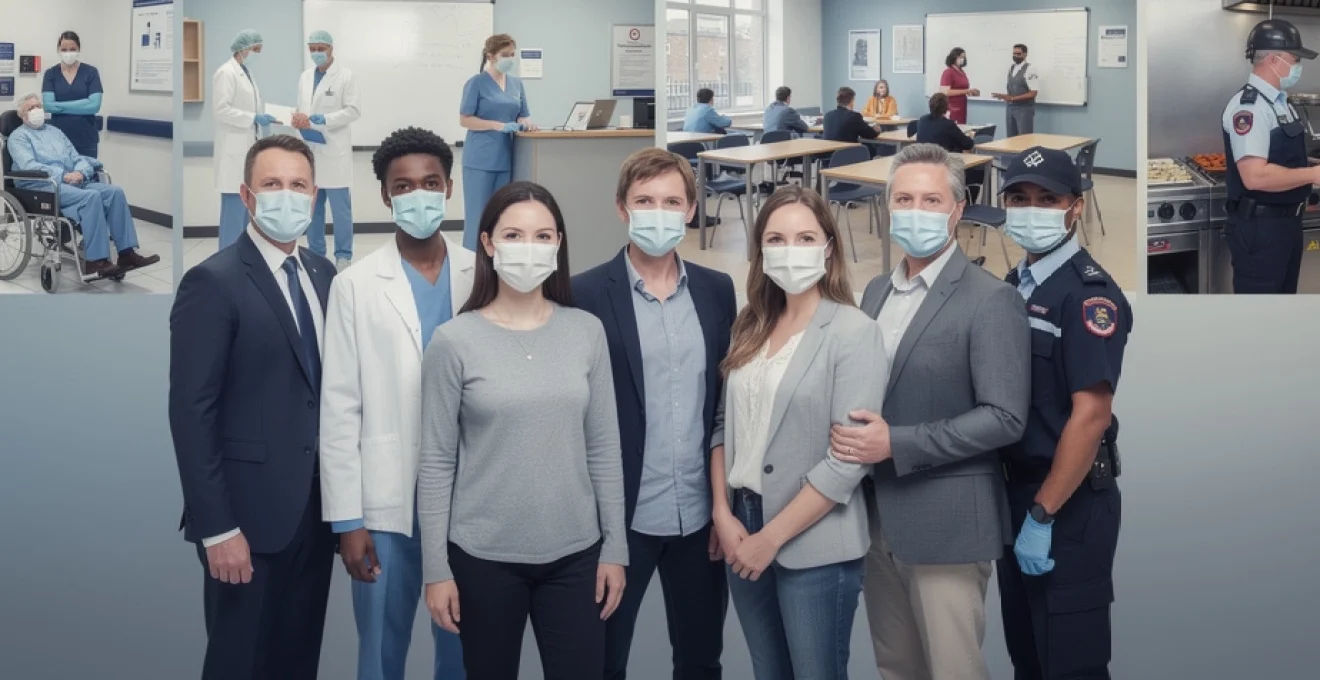
Face covering requirements have evolved significantly throughout the United Kingdom, transforming from emergency pandemic measures to established protocols in specific sectors. Understanding when mask wearing remains mandatory requires navigating a complex landscape of health regulations, workplace safety standards, and industry-specific requirements. While the legal obligation to wear face coverings in most public spaces ended in England on 27th January 2022, numerous circumstances still necessitate mandatory mask usage across various settings.
The current regulatory framework maintains mandatory face covering requirements in healthcare environments, certain transport scenarios, and specific workplace conditions where respiratory protection forms part of established safety protocols. These requirements stem from different legislative sources, ranging from infection prevention control guidelines to occupational health and safety regulations. Professional understanding of these obligations helps ensure compliance while protecting public health and workplace safety.
UK government statutory mask requirements under public health legislation
The statutory framework governing mandatory mask requirements operates through multiple layers of public health legislation, with different authorities maintaining specific powers to enforce face covering obligations. While the Health Protection (Coronavirus Restrictions) Regulations 2020 provided the initial legal foundation for widespread mask mandates, subsequent amendments and sector-specific guidance have created a more nuanced regulatory environment.
Health protection (coronavirus restrictions) regulations 2020 framework
The original regulatory framework established under the Health Protection Act 1984 created comprehensive powers for implementing face covering requirements during public health emergencies. Although the general public mandate ended, these regulations continue to provide legal backing for specific sectoral requirements. Healthcare settings, for instance, maintain mandatory face covering protocols under infection prevention and control guidance that derives authority from these foundational regulations.
Local authorities retain emergency powers under this framework to implement temporary mask mandates during outbreak situations. These powers enable rapid response to emerging health threats, with enforcement mechanisms including fixed penalty notices and potential prosecution for persistent non-compliance. The regulatory structure allows for proportionate responses based on local epidemiological evidence and risk assessments.
NHS england clinical commissioning group mandates for healthcare settings
NHS England maintains comprehensive face covering requirements across all healthcare facilities, implemented through clinical commissioning group mandates and infection prevention control protocols. These requirements apply universally to staff, patients, and visitors in hospital settings, primary care facilities, and community health services. The mandate extends beyond COVID-19 protection to encompass broader respiratory infection control measures.
Clinical areas maintain particularly strict enforcement, with face coverings required from the moment individuals enter healthcare premises until departure. Emergency departments, intensive care units, and vulnerable patient areas implement enhanced protocols, often requiring surgical-grade face masks rather than basic cloth coverings. Staff working in high-risk environments may face additional requirements, including N95 respirators or equivalent protection.
Local authority emergency powers and mask enforcement protocols
Local authorities possess significant discretionary powers to implement temporary mask mandates during public health emergencies or outbreak situations. These powers operate independently of national legislation, enabling rapid local responses to emerging health threats. Environmental health departments typically coordinate enforcement activities, working with trading standards officers and community safety teams.
Enforcement protocols vary considerably between local authorities, with some implementing educational approaches while others prioritise immediate penalty notices. Fixed penalty notices for mask-related offences can range from £200 to £10,000 for repeat offenders, depending on the specific circumstances and applicable regulations. Business operators may face additional penalties for failing to ensure customer compliance with local mandates.
Care quality commission standards for residential care facilities
The Care Quality Commission maintains stringent face covering standards for all registered care facilities, implemented through fundamental standards of care and infection prevention requirements. These standards apply universally across nursing homes, residential care facilities, and supported living environments. Failure to maintain appropriate face covering protocols can result in regulatory action, including improvement notices and potential service restrictions.
Care facility operators must ensure comprehensive compliance across all staff, visitors, and service providers entering their premises. The requirements extend to maintenance workers, delivery personnel, and healthcare professionals providing services within care environments. Regular auditing and compliance monitoring form essential components of CQC inspection processes, with face covering protocols scrutinised during regulatory visits.
Transport for london and national rail mandatory face covering policies
Transport networks across the United Kingdom maintain varying face covering requirements, with individual operators exercising discretion over mandatory policies. While legal requirements
have been lifted in most circumstances, operators can still impose mandatory mask rules as a condition of carriage. This means that even where there is no national law compelling the use of face coverings, you may still be contractually required to wear a mask to use certain services. Transport for London (TfL), National Rail operators, and some regional transport bodies periodically reinstate mandatory mask policies in response to seasonal surges in flu, COVID-19, or other respiratory infections, particularly in the winter months.
From a practical perspective, passengers should always check the latest guidance from the relevant transport operator before travelling. Mask mandates may apply only in specific areas, such as enclosed station concourses, or at particular times, such as during peak-hour congestion or active outbreaks. These mandatory face covering policies, when in force, are usually backed by byelaws, conditions of carriage, or health and safety obligations, and non-compliance can result in removal from services or civil penalties.
Tfl tube, bus and overground mask requirements
TfL retains the ability to introduce mandatory face covering rules on the London Underground, buses, trams, DLR and London Overground services under its conditions of carriage and network byelaws. During periods of heightened respiratory risk, TfL may require passengers to wear a face covering at all times within stations, on platforms, and on vehicles, unless they are exempt. These measures are typically aligned with advice from the Mayor of London, the UK Health Security Agency, and local public health teams.
When mask rules are in force, you are expected to put your face covering on before entering the station and keep it in place for the duration of your journey, including on escalators, lifts and in ticket halls. Enforcement is usually carried out by TfL staff and British Transport Police officers, who can deny boarding or ask non-compliant passengers to leave the network. While fixed penalties are less common than during the peak of the pandemic, deliberate refusal to comply with a clear mandatory mask rule can still lead to fines under transport byelaws.
Exemptions are broadly consistent with national guidance, typically covering children under a specified age (often under 11), people with certain disabilities or health conditions, and those who rely on lip reading. TfL has previously encouraged the use of exemption badges or cards to help exempt passengers feel more comfortable, although these are not a legal requirement. As with other settings, the expectation is that staff and fellow passengers remain respectful, recognising that not all reasons for being unable to wear a face covering are visible.
Network rail station concourse and platform regulations
National Rail and Network Rail-managed stations also retain discretion to require face coverings in enclosed or crowded areas. These mandatory rules, when applied, usually cover indoor concourses, waiting rooms, retail areas within stations, and enclosed platforms. The rationale is straightforward: confined spaces with limited ventilation and high passenger turnover increase the risk of respiratory virus transmission, making masks a proportionate control measure during outbreaks.
Individual train operating companies (TOCs) can complement Network Rail guidance with their own conditions of carriage, specifying when and where passengers must wear a mask on trains and in associated facilities. If a mandatory rule is active, refusal to wear a face covering without a valid exemption can be treated as a breach of contract, potentially leading to removal from the train or denial of travel. In practice, many operators adopt a “supportive enforcement” approach, focusing first on reminders and the offer of free masks before considering formal action.
For commuters and occasional travellers alike, the safest approach is to carry a suitable face covering whenever you use rail services, even when no general mandate is in place. Seasonal announcements, station signage, and operator websites will usually flag any temporary return to mandatory mask usage. Think of it much like carrying an umbrella in autumn: you may not need it on every journey, but when conditions change suddenly, you will be glad you have it.
Civil aviation authority aircraft cabin mask protocols
Mandatory mask requirements in aviation are shaped by a combination of airline policy, destination country rules, and guidance from the Civil Aviation Authority (CAA) and international bodies. While blanket legal mandates have been relaxed, airlines still have the right to insist on face coverings as a condition of carriage, particularly when flying to or from jurisdictions where masks in aircraft cabins remain compulsory. Cabin crew may also be required to wear masks during specific phases of the flight or when serving vulnerable passengers.
When an airline declares face coverings mandatory, passengers are usually expected to wear a mask from boarding until disembarkation, except when eating, drinking, or where an approved medical exemption applies. Failure to comply can be treated as disruptive behaviour under aviation security rules, with potential consequences ranging from warnings and seat changes to refusal of carriage and reporting to authorities. Because cabin air is recirculated and passengers are seated in close proximity for extended periods, mandatory masks can significantly reduce the risk of airborne transmission during higher-risk periods.
You should always check your airline’s latest health and safety guidance before travelling, as mask rules can change with little notice in response to emerging variants or public health advisories. Some carriers accept only specific types of masks (for example, no valve masks or scarves), so it is sensible to bring several compliant face coverings in your hand luggage. If you require an exemption, you may be asked to provide medical documentation in advance, so allowing extra time for approval is essential.
DVSA commercial vehicle and taxi licensing mask stipulations
The Driver and Vehicle Standards Agency (DVSA) and local licensing authorities play a key role in determining mask requirements for professional drivers, including taxi, private hire, and commercial vehicle operators. During periods of heightened risk, local councils can stipulate that licensed taxi and private hire drivers must wear face coverings when transporting passengers, with the requirement often extended to passengers themselves. These conditions may be written into licensing terms, meaning that non-compliance can affect a driver’s licence status.
In vehicle testing and training environments, the DVSA may also impose mandatory face covering rules for examiners, instructors, and candidates, particularly in shared-vehicle scenarios such as driving tests. Because these interactions take place in confined spaces, often for extended periods, masks can form a critical layer of protection alongside ventilation and regular cleaning. When mandatory, candidates who refuse to wear a face covering without a valid exemption may have their test cancelled and fees forfeited.
For taxi and private hire operators, communicating mask requirements clearly to passengers—via in-vehicle signage, booking apps, or websites—helps avoid disputes and supports compliance. Where exemptions apply, drivers should be trained to handle conversations sensitively, balancing their own health concerns with equality obligations. Just as seat belt rules are now second nature, clearly communicated mask expectations can become part of everyday professional driving practice during higher-risk seasons.
Healthcare sector PPE compliance and infection prevention control
Beyond public transport, the healthcare sector remains the primary domain where mask wearing is routinely mandatory. Infection prevention and control (IPC) guidance for the NHS and independent healthcare providers sets out detailed requirements for when staff, patients, and visitors must wear face coverings or higher-grade respiratory protection. Unlike short-term public health regulations, these protocols are embedded into clinical governance frameworks and are reviewed regularly in light of emerging evidence.
In most acute hospital settings, masks are mandatory in clinical areas where patients are assessed, treated, or cared for, especially when dealing with respiratory symptoms. Staff may be required to wear fluid-resistant surgical masks (FRSMs) as a baseline, with FFP2 or FFP3 respirators mandated for aerosol-generating procedures or when caring for patients with known or suspected airborne infections. These rules are not merely advisory; failure to adhere can trigger internal disciplinary procedures and negative findings in external inspections.
For patients and visitors, mandatory mask policies typically apply on entry to hospitals, GP surgeries, and outpatient clinics, particularly during winter months or outbreak periods. Some trusts make mask wearing compulsory only in clinical zones, while others extend the requirement to corridors, waiting areas, and lifts where social distancing is difficult. Exemptions still apply—such as for young children, certain disabilities, or individuals in distress—but staff are usually trained to balance strict infection control with compassionate, person-centred care.
Community healthcare services, including district nursing, mental health teams and rehabilitation services, may also enforce mask wearing when staff enter patients’ homes or when clinics are held in shared community spaces. These mandatory requirements are driven by risk assessments that consider patient vulnerability, local infection rates, and the type of care being delivered. From your perspective as a patient or carer, it is helpful to assume that mask usage will be required in most healthcare interactions and to bring a suitable face covering to all appointments.
Educational institution mask mandates under department for education guidelines
Mask requirements in schools, colleges and universities have shifted from blanket national mandates to more targeted, risk-based measures guided by the Department for Education (DfE) and public health teams. Under current arrangements, there is usually no standing legal obligation for pupils or staff to wear face coverings in classrooms. However, mandatory mask rules can be reintroduced temporarily in response to local outbreaks, high community transmission, or the emergence of new variants.
When invoked, these mandatory measures generally apply to secondary school pupils (Year 7 and above), further education students, and higher education settings, particularly in communal areas such as corridors, assembly halls, and transport to and from school. Masks may also be required in classrooms for a limited period where public health advice indicates that additional controls are necessary to keep settings open. Headteachers and governing bodies have some discretion to strengthen or relax mask rules within the framework of DfE guidance and local health protection advice.
Exemptions in education mirror those used elsewhere, covering pupils and staff who cannot wear face coverings due to disability, health conditions or severe distress. To avoid stigma, many schools adopt a “no questions asked” approach, trusting families to self-identify where exemptions apply and offering optional exemption badges or lanyards. At the same time, schools must balance individual needs with their duty to protect clinically vulnerable pupils and staff, sometimes designating specific “mask-required” zones or times to manage risk.
For parents and students, the practical takeaway is to stay alert to communication from your school or college, particularly during winter. A setting that operates mask-free most of the year may suddenly move to mandatory face coverings following advice from local public health teams. Having a small supply of comfortable, well-fitting masks ready for these periods can help minimise disruption and ensure that learning continues as smoothly as possible.
Workplace health and safety executive risk assessment mask requirements
In the broader workplace, the Health and Safety Executive (HSE) plays a central role in determining when mask wearing becomes mandatory as part of an employer’s duty of care. While general public face covering laws have eased, employers still have a legal obligation under the Health and Safety at Work etc. Act 1974 to protect workers from reasonably foreseeable risks. Where a risk assessment identifies respiratory hazards—whether from infectious diseases, dust, fumes, or chemicals—mandatory masks or respirators may form a key control measure.
In many office-based environments, the primary focus has shifted to ventilation, hybrid working, and general hygiene practices, with masks encouraged rather than required except during outbreak situations. However, in sectors such as manufacturing, healthcare, social care, construction and food processing, mandatory mask or respirator use remains common under established safety protocols. Failure to provide appropriate respiratory protective equipment (RPE), or to ensure that staff wear it correctly, can result in enforcement notices, improvement orders, and, in serious cases, prosecutions.
Employers who wish to introduce or retain mandatory face covering policies must document their reasoning in a written risk assessment, outlining why masks are necessary, what type is required, and how they will be supplied and monitored. They must also consider equality implications and provide reasonable adjustments for staff who cannot wear standard masks, for example by offering alternative PPE or adjusting duties. From the worker’s perspective, understanding that mask rules are usually grounded in a formal risk assessment can make compliance feel less arbitrary and more clearly linked to tangible safety benefits.
COSHH regulations and respiratory protection standards
Under the Control of Substances Hazardous to Health (COSHH) Regulations, employers are legally required to control exposure to hazardous substances, including airborne contaminants such as dusts, fumes, vapours and biological agents. Where engineering controls and safe systems of work cannot sufficiently reduce exposure, the use of respiratory protective equipment becomes mandatory. This is not a matter of preference; it is a regulatory requirement supported by HSE guidance and, where relevant, British and European standards.
In practice, this means that workers in laboratories, manufacturing plants, healthcare environments, and certain service sectors must wear specific types of respirators—often FFP2, FFP3 or equivalent—when working with hazardous materials. Unlike general cloth face coverings, these respirators must be properly selected, fit-tested, and maintained to ensure they provide the intended level of protection. Employers must train staff on correct usage, storage and disposal, and should conduct periodic checks to ensure ongoing compliance and effectiveness.
If you work in an environment covered by COSHH, refusing to wear mandated respiratory protection without a valid reason can be treated as a refusal to follow health and safety instructions. This may have disciplinary consequences and, in extreme cases, could jeopardise your employment. Just as wearing a hard hat on a construction site is non-negotiable where there is a risk of falling objects, wearing approved respiratory protection is mandatory where air quality and hazardous substances pose a significant risk.
Construction industry scheme face covering protocols
The construction industry, governed by a combination of HSE rules and sector-specific guidance, frequently mandates face coverings or respirators where dust, particulates or close-contact working create significant risk. During the height of the pandemic, many construction sites introduced mandatory cloth or surgical masks for COVID-19 control, alongside respirators required under COSHH for tasks like cutting, drilling, or working with silica-containing materials. While broad pandemic measures have eased, mandatory RPE under traditional safety rules remains firmly in place.
Site managers typically conduct task-specific risk assessments to determine when masks or respirators are mandatory. For example, working in confined spaces, poorly ventilated indoor areas, or in close proximity to others for extended periods may trigger a requirement for face coverings during outbreak conditions. Separately, high-dust activities almost always demand properly rated respirators, regardless of infection risk, to protect workers’ long-term respiratory health.
From a worker’s viewpoint, it can help to think of mask requirements as part of a wider “hierarchy of controls” that includes barriers, extraction systems, and safe working distances. Masks are often the last line of defence, stepping in where other controls cannot fully eliminate risk. Knowing this, most construction professionals accept that properly specified and enforced mask rules are as fundamental to site safety as scaffolding inspections or fall-arrest systems.
Food standards agency hygiene requirements for catering establishments
In the food sector, mask wearing sits alongside hygiene rules on handwashing, PPE, and contamination control, with oversight from the Food Standards Agency (FSA) and local environmental health officers. There is rarely a blanket legal requirement that all food handlers must wear face masks at all times. However, catering establishments may be required, or may choose, to make masks mandatory in specific situations to meet their duty to prevent contamination and protect staff and customers.
During outbreaks of respiratory illness, for example, an employer may introduce compulsory masks for kitchen staff, servers, and delivery personnel as part of a wider infection control plan. Similarly, staff who are mildly symptomatic but deemed fit to work under local policies might be required to wear a mask to reduce the risk of spreading infection, provided this is compatible with food safety standards. Environmental health inspections will often consider whether an establishment’s approach to PPE, including face coverings, is proportionate to the risks identified.
Front-of-house mask requirements may also be used to reassure customers, particularly in settings catering to older or clinically vulnerable clientele. Where such policies are mandatory for staff, they should be clearly explained in training and reinforced through supervision and signage. For you as a customer, the presence of masked staff can be a visible indicator that a venue takes hygiene and respiratory protection seriously, much like observing regular surface cleaning or the use of gloves in appropriate tasks.
Enforcement mechanisms and fixed penalty notice procedures
Even as general mask mandates have receded, enforcement mechanisms remain in place wherever mask wearing is still mandatory under law, regulation, or binding contractual conditions. Depending on the setting, non-compliance may attract fixed penalty notices, removal from premises, or, in more serious cases, prosecution. Public health legislation, transport byelaws, workplace safety laws, and care standards regulations each provide different tools for enforcing mandatory mask rules when they are in force.
In public settings such as healthcare facilities or transport networks, authorised officers may issue fixed penalty notices to individuals who refuse to comply with clear, signposted mask requirements without a valid exemption. Penalties can escalate for repeat offences, reflecting the cumulative risk posed by persistent non-compliance. While many authorities now favour an “engage, explain, encourage” approach, they retain the power to move swiftly to formal sanctions where behaviour is wilfully obstructive or puts others at significant risk.
Workplaces and regulated premises, including care homes and food businesses, primarily enforce mask rules through internal policies, disciplinary procedures, and regulatory inspections. Employers must be able to demonstrate that they have communicated requirements clearly, provided appropriate PPE, and considered reasonable adjustments. Regulators such as the HSE, CQC, and local environmental health teams can issue improvement notices, prohibition notices, or fines where systemic failures to enforce mandatory protective measures, including masks, are identified.
For individuals, the most effective way to avoid enforcement action is straightforward: stay informed, follow clearly displayed mask requirements, and communicate proactively if you believe you are exempt or unable to comply. If you are unsure whether masks are mandatory in a given setting, asking a member of staff or checking the organisation’s website before you arrive can prevent misunderstandings. In a landscape where mask rules are more targeted and context-specific than ever, a little preparation and mutual respect go a long way toward keeping everyone safe and minimising the risk of penalties.